
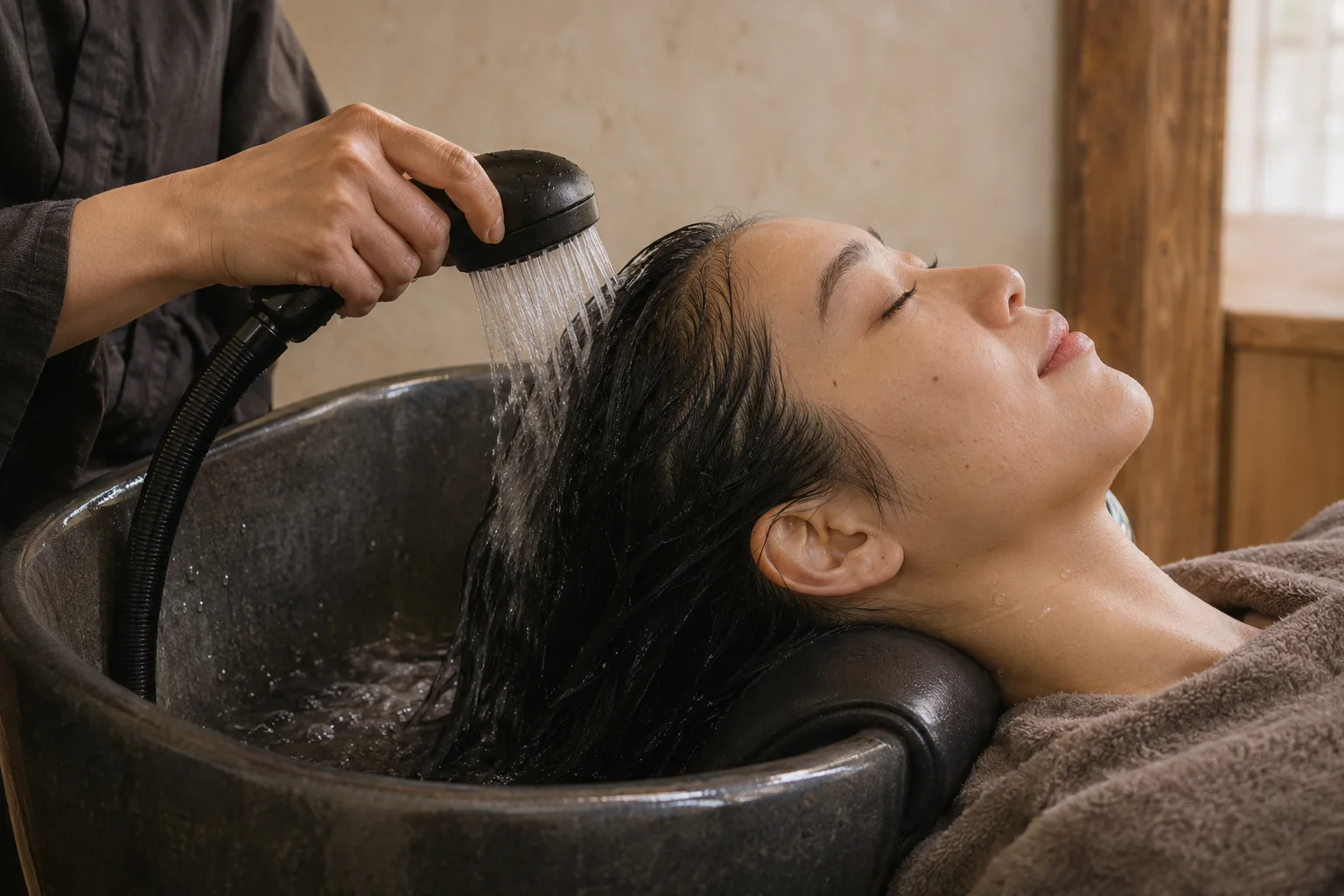
A directed rinse carries away shampoo. A head bath, by contrast, partially immerses the hair. AI illustration.
In a salon in Taipei, the shampoo can begin while you sit upright facing the mirror. In an Indian home, the person working oil into your roots may be your mother, and washing it out may be a job for later. At a head spa in Seoul, you might start by looking at a single parting of your hair on a screen. Book all three as a “scalp experience” and you would still have three quite different afternoons.
The best clue to what you are booking is a verb. Will someone wash, massage, condition, examine or bathe your scalp? Most menus combine two or three of these. A few add a facial or a professional hair finish. This guide follows those gestures across countries, with named examples so you can see what a practitioner actually offers. Some are head spas in the modern salon sense; others are older or parallel practices with names and purposes of their own.
Japan: a head bath and a dry head spa are two different bookings
In a wet head spa, you recline at a basin. The stylist can part the hair, work cleanser into the roots, massage the scalp and rinse without moving you to another chair. There is a small but appreciable pleasure in that arrangement: someone else supports the weight of your wet hair while you close your eyes. If the hands-on shampoo is the part you love at the hairdresser, this is the family of treatments to explore first.
A head bath, sometimes listed as tōshinyoku, is a particular water stage. On the YUME Headbath made by Takara Belmont, warm water flows along the hairline while the back of the head and hair sit in water. That differs from rinsing shampoo away with a handheld sprayer, or from a perforated ring sending several small streams across the hair. All three can feel lovely. Only one of them requires a bath deep enough for immersion. Ask which is pictured on the menu if the sound and sensation of running water are why you are going.
Japan also has dedicated dry head spas. Goku no Kimochi, which opened its Kyoto salon in 2008, describes a waterless, hands-on approach. It is a good illustration of why “Japanese” need not mean shampoo, steam or a waterfall. Choose dry if you want the sensation of massage and have no interest in a wash. Dry describes the absence of water; still ask about styling products and whether the massage will disturb your parting or updo.
South Korea: what the scalp camera adds
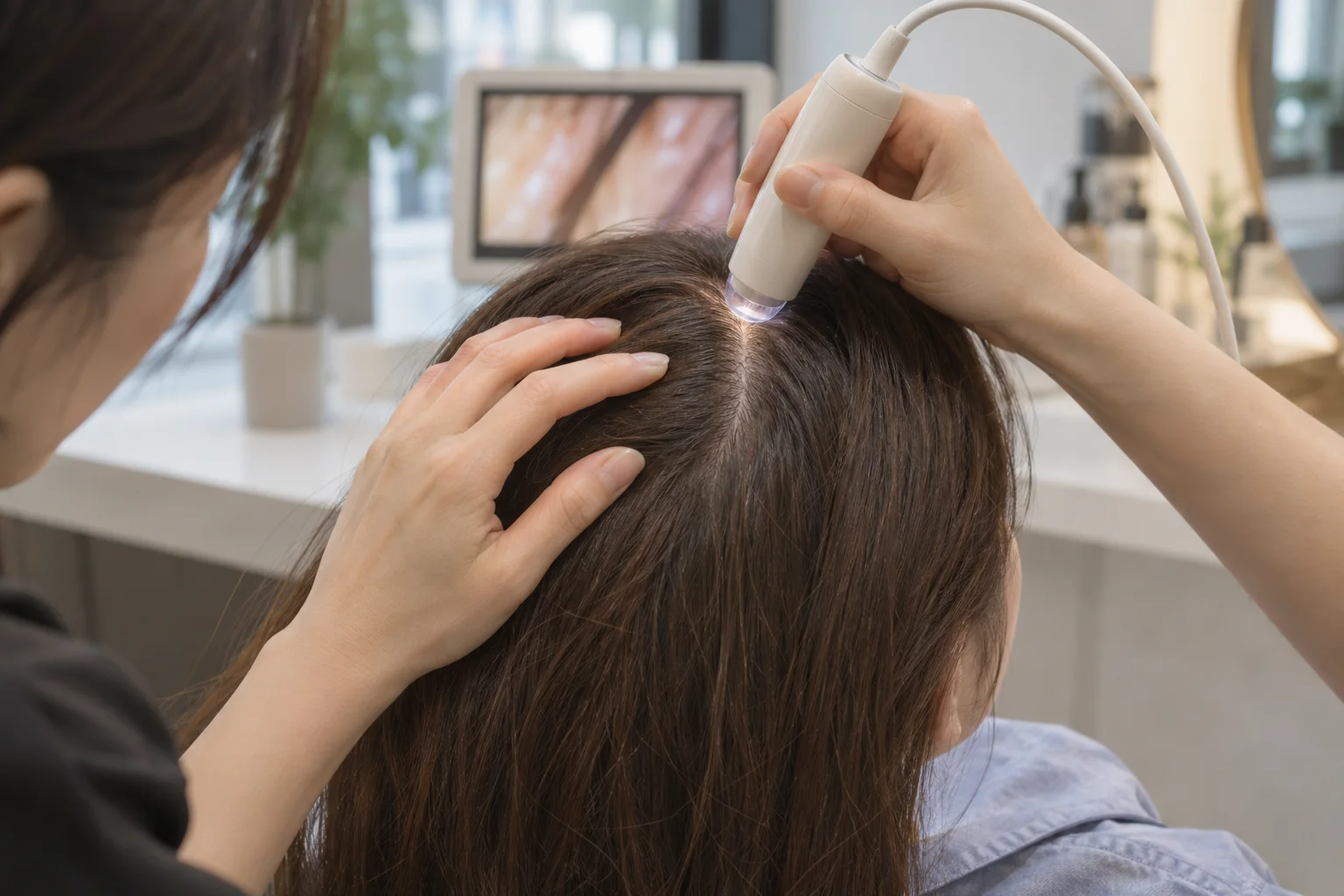
In Seoul, a scalp-care appointment can begin with a consultation in front of a monitor. A practitioner parts the hair and places a small magnifying camera against the part, so you can look together at surface oil, flakes or styling residue. On some menus, scaling means a cosmetic cleansing or exfoliating stage. It is worth asking what that particular salon uses: a shampoo, a scrub and a specialist tool are different experiences on the skin.
At Eco Jardin in Cheonho, the published courses include a microscope consultation and a second look after care. Its longer programme adds scalp massage, an herbal pack and a steam cap. That is one salon's sequence, not a Korean national protocol. Nor does a cleaner-looking parting show that hair is growing faster. The value of the camera is more immediate: it can turn “go easy here” into a conversation about one precise place on your head.
Vietnam: the wash that makes room for the shoulders
Look for gội đầu dưỡng sinh on a Vietnamese menu. For a visitor, it helps to think of a hair wash with time set aside for touch. Depending on the address, a practitioner may work around the scalp, temples, neck and shoulders, moving between water and massage. The easiest mistake is to translate it simply as “shampoo” and expect a quick stop before dinner. Check the finish as well as the length of the session.
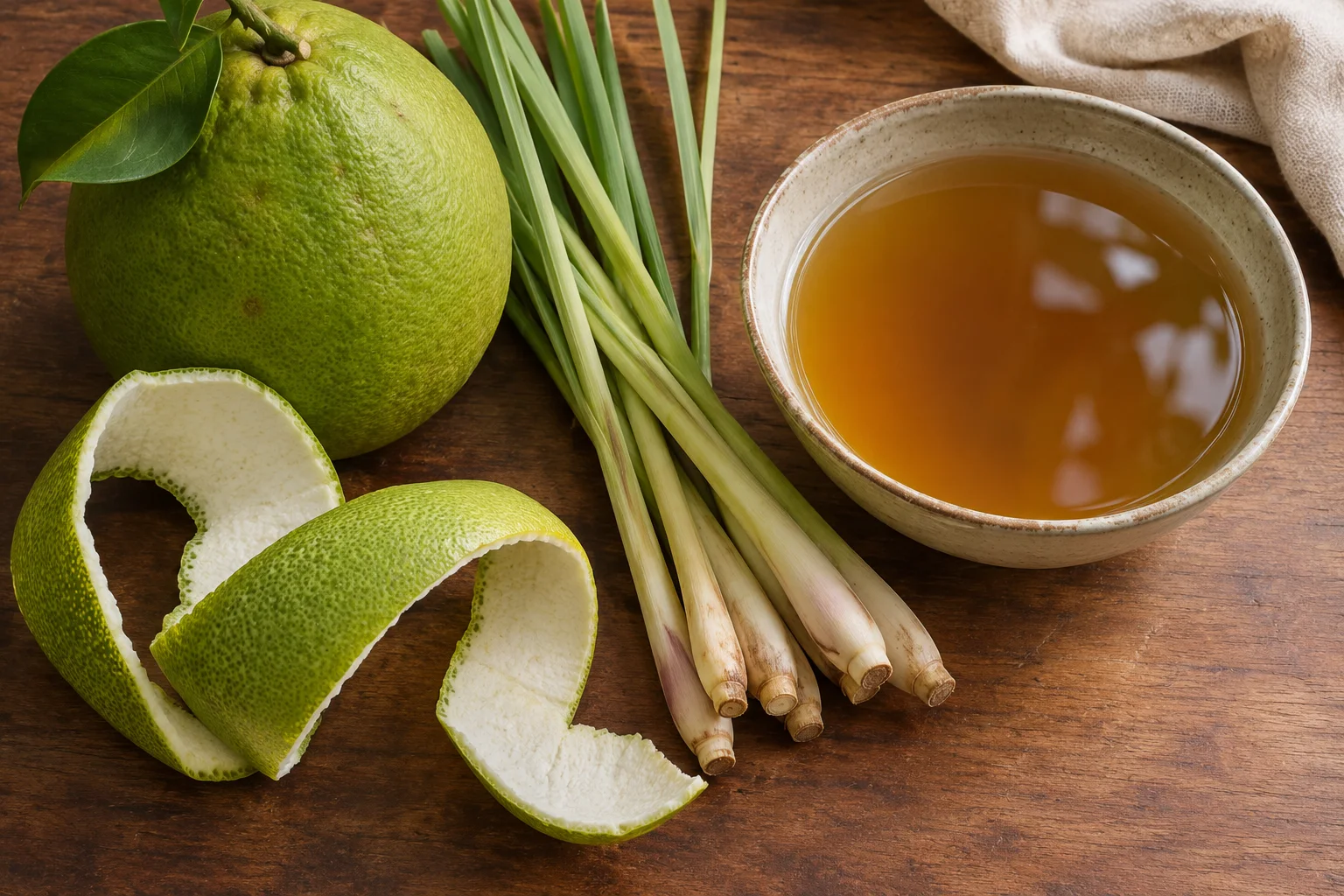
The scent is often what distinguishes two menus. Spahem in Hội An describes washes with bồ kết, the pods of a tree used in hair washing, and pomelo. An herbal wash may also use a prepared shampoo; the name does not tell you whether everything in the bowl was brewed on the premises. If perfume bothers you, request the ingredient list or an unscented alternative. If it is the neck massage that appeals, check that it belongs to the shorter course you are considering.
Taiwan: why a stylist can shampoo you in the chair
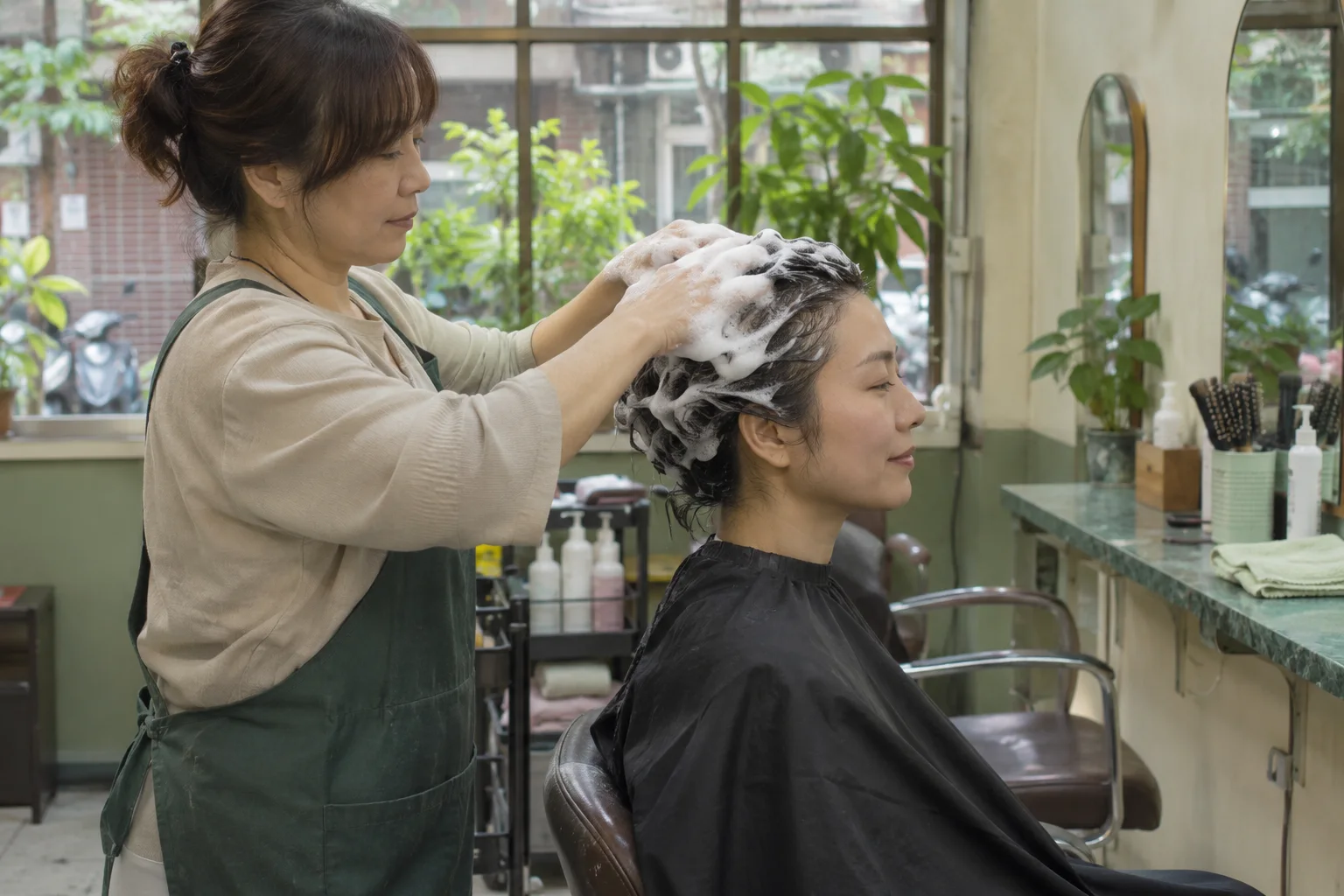
A Taiwanese seated shampoo begins at the styling station. The stylist works a little liquid and shampoo into the hair and builds lather while the guest remains upright. The rinse comes at the basin. The foam holds together surprisingly well; some stylists play with its shape, but the real trick is producing enough lather to wash the hair without sending suds down the back of the chair. JCB's first-hand visit to a Taipei salon gives a glimpse of this salon custom.
For someone who dislikes spending a whole treatment reclined, a seated wash offers a useful distinction: less time at the basin is possible, though a rinse is still necessary. Ask whether your booked service is the seated version. Many salons also offer an ordinary reclining wash, and a photograph of sculpted foam does not tell you how much time is spent massaging or whether styling is included.
India: champi, head oil massage and shirodhara
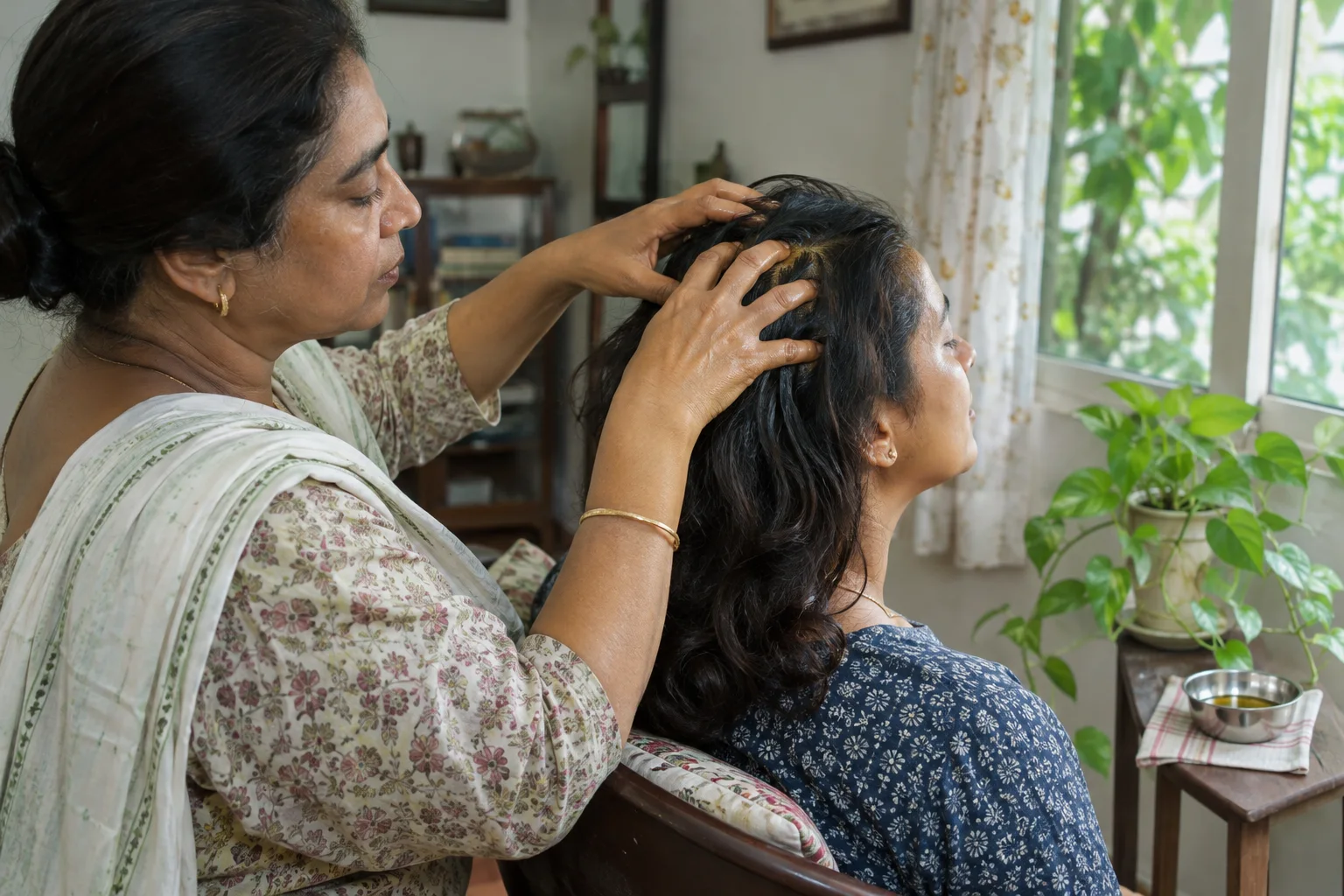
In champi, the main event is a pair of hands. In the oil version described in Indian vocational training material, oil is applied to the scalp and worked in with the fingers. At home, it can be shared care; in a salon, the service may include the neck and shoulders or a wash afterwards. Oil is a useful question to settle up front: are you meant to leave with it in your hair, or does the appointment end at a basin? It matters if you are heading straight back to work.
Shiro abhyanga is a term you may see for an Ayurvedic head oil massage. Shirodhara describes a different action: a steady stream of liquid is directed onto the forehead of a reclining guest. Kerala Tourism's demonstration makes the distinction easy to see. A stream on the forehead is neither a shampoo rinse nor a synonym for all Indian head massages. If you want fingers working through the roots, book for massage; if you want to experience the pour, ask for that specific practice and who provides it.
Indonesia: what makes a creambath a creambath?
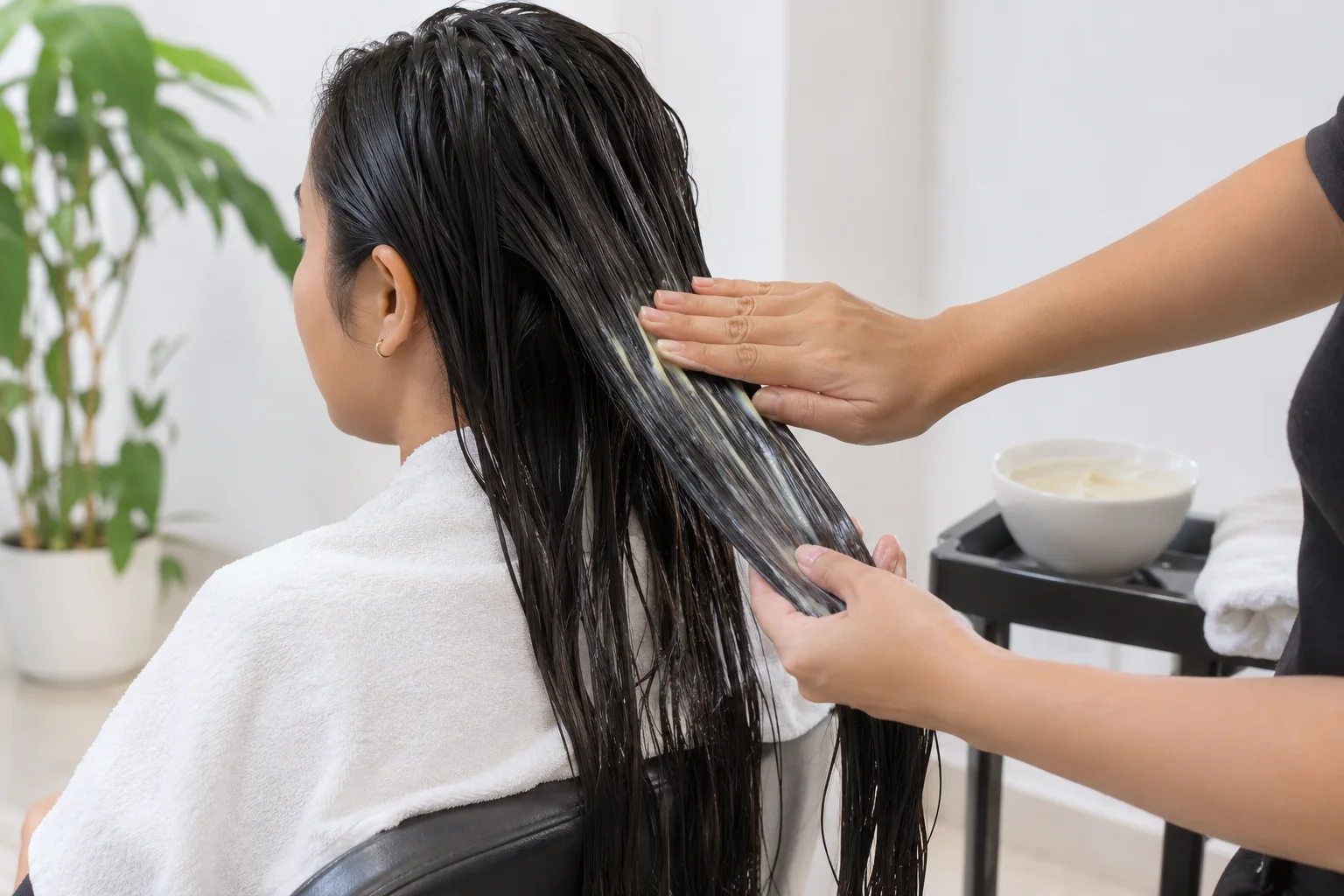
An Indonesian creambath is especially interesting if you care as much about the lengths of your hair as the skin underneath. A conditioning cream is worked through the hair, with time for scalp massage. At Espace Spa in Canggu, the guest also receives neck and shoulder massage while the conditioner sits under a steamer. Rudy Hadisuwarno's Indonesian salon menu shows the creambath in a hairdressing setting. Neither the steamer nor a particular fruit fragrance is what defines every version.
Imagine choosing between this and the seated shampoo in Taiwan. Both may end with clean, dry hair. In one, the pleasure is the shampoo itself, lather slowly built at the chair; in the other, conditioning and massage occupy time that would otherwise be spent waiting for a product to rinse out. For fine hair, ask where the cream will be applied. For dense curls, ask how the stylist will work it through and how they plan to detangle and dry the lengths.
Chinese herbal head care: read the house recipe
In Chinese-style herbal head-care salons, the distinctive feature may be the wash liquid or herbal steam rather than the shape of the basin. Menus from the same tradition can offer different combinations. For example, Tou Dao Tang's Malaysian menu describes a branded approach to herbal head care. Treat its ingredients and sequence as that operator's choices. “Chinese herbal” is a starting point for a question, not the name of one product or a guarantee that a preparation will suit sensitive skin.
This is also a good example of how practices travel. A Chinese-inspired service in Malaysia does not become a centuries-old Malaysian ritual by virtue of its address. Conversely, asking only whether it is “authentic” tells you little about your visit. Ask what will touch your scalp, whether heat is used, and which parts of the appointment you can leave out.
Thailand: when scalp care shares an appointment with a facial
Bangkok menus often put several distinct services within a few lines of one another. A head-and-shoulder massage can leave the hair unwashed. A head spa can combine a cleansing sequence with neck and shoulder work. A hair-and-facial ritual adds actual care for the skin of the face. Traditional Thai massage, or Nuad Thai, has its own history and practice, documented by UNESCO; the word “Thai” on a modern head-spa menu does not make the whole shampoo sequence part of that tradition.
At House of Pridi in Bangkok, the Classic Head Spa lasts 75 minutes and concentrates on hair and scalp, with massage, water and a blow-dry. The Hair & Facial Spa Ritual combines both areas in 90 minutes. The Signature Scalp & Facial Spa takes 120 minutes, with a scalp mask, Indian-inspired head massage and facial care among its stages. The entire two hours are shared among those elements. Choose Classic if it is the basin you want; choose one of the combined sessions if you would otherwise book a facial separately.
Morocco and the hammam: a neighbouring tradition
In a Moroccan hammam the central experience is bathing, not a salon appointment devoted to the head. Hair care can still have a place. Morocco's national tourism office describes rhassoul, or ghassoul, a clay mixed with water and used in care for hair as well as skin. A clay preparation feels and rinses differently from shampoo foam, oil or a slippery conditioning cream. If a hammam menu mentions rhassoul, ask whether the clay is applied to the body, hair or both.
This distinction matters for the comparison: one should not rebrand the hammam as a “Moroccan head spa”, any more than a blow-dry becomes a scalp massage because someone washes the hair first. Look instead at what the treatments share: warm water, time set aside for washing, and the possibility that another person helps with a part of bathing you usually do alone.
How the head spa travels: Paris, New York, Brazil and Melbourne
Japanese Head Spa Paris explicitly describes its services as inspired by Japan, while ScalpTox in New York offers a dry interpretation. A traveller could book a Japanese-inspired service in both cities and come away with wet hair in one and no shampoo at all in the other. The label is a clue to influence; the list of steps tells you what to bring and whether to budget for styling.
In Brazil, spa capilar or terapia capilar can lead you to a salon programme centred on the scalp and hair. Mariá's Hair Boost menu combines an assessment with a reclining Japanese basin: an example of Brazilian practice borrowing specific equipment. Australian menus make another useful distinction. Visit Melbourne's listing for Hair Spa Melbourne separates a basic dry-off from a professional blow wave. If you are booking before an evening out, that single detail may matter more than the number of steps in the ritual.
Choose by the part you want to remember
| If you most want… | Start by looking for… | Ask before booking |
|---|---|---|
| Warm water moving through the hair | Japanese wet head spa or head bath | Is it a handheld rinse, a ring or immersion? |
| Uninterrupted touch without a wash | Dry head spa or head massage | Do you use any oil or leave-in product? |
| A look at the scalp with the practitioner | Korean-style scalp-care consultation | What do you see, and which steps are optional? |
| A fragrant wash and neck work | Vietnamese herbal wash | What goes into the wash, and is drying included? |
| Softness through the lengths | Indonesian creambath | Where does the cream go, and how is my hair finished? |
| Time for the face as well as the hair | A combined head spa and facial | What facial steps are included in the total time? |
For curls and coils, the conversation need not be complicated. Say how you normally detangle, whether you want the hair stretched or left in its curl pattern, and whether you would like a diffuser. The American Academy of Dermatology's curl-care guidance explains why sectioning and detangling with conditioner can help. With braids, extensions or a recent colour service, describe exactly what you have before reserving; a salon may need different products, more drying time, or an entirely different appointment.
Finally, a relaxing treatment is a reasonable end in itself. A magnifying camera, an oil or a scrub cannot establish why you have persistent itch or hair loss. Pain, broken skin or new patches of hair loss are reasons to postpone cosmetic work on the area and ask a dermatologist; the AAD's guide to an itchy scalp explains how different causes call for different care. For an ordinary afternoon at the salon, the useful test is simpler: can you tell the person treating you where you want pressure, which scent you dislike, and how you hope your hair will feel when you walk out?
Read further: Japanese head baths and Korean scalp care, step by step · Oil, cream and clay: three traditions explained.
Make time for yourself
Your next ritual begins here.
Discover massage, facial and hair spa experiences at our Bangkok sanctuary.
Explore your next visit ↗